PHOENIX AIR UNMANNED, LLC
Excellence in Standards
Phoenix Air Unmanned (PAU) is a group of aviators dedicated to following best practices that far exceed industry standards. Our operation applies the stringent operating procedures of our sister company -- Part 135 air carrier, Phoenix Air Group. We pride ourselves on our commitment to aviation safety and our ability to work with federal regulators to complete complex unmanned aircraft operations.
Aviators First
Phoenix Air Unmanned (PAU) is a group of accomplished aviators. Our certificated pilots hold manned aircraft ratings and are passionate about working in the field of aviation. PAU does not contract a network of operators across the country, but instead, operates with a core group of highly-skilled individuals who are qualified to pilot both manned and unmanned aircraft in the National Airspace System.
Add paragraph text. Click “Edit Text” to customize this theme across your site. You can update and reuse text themes.
Pilot Proficiency
PAU pilots and flight support staff remain proficient in unmanned aircraft flight operations. Flight crews abide by internal company currency requirements, attend recurrent training sessions, and operate within a manned aviation company hierarchy of standardization and instructor pilots to perform training and assessments.
PAU pilots and flight support staff remain proficient in unmanned aircraft flight operations. Flight crews abide by internal company currency requirements, attend recurrent training sessions, and operate within a manned aviation company hierarchy of standardization and instructor pilots to perform training and assessments.

Phoenix Air Unmanned believes in exceeding qualification requirements to offer the industry a safe, professional, and highly-qualified team of remote pilots, sensor operators, and maintenance technicians. PAU requires all remote pilots to have a minimum FAA Private Pilot certificate, FAA Part 107 sUAS Commercial Remote Pilot certificate, and current FAA medical certificate. All PAU flight crew are required to have a current First Aid/CPR certification and biennial defensive driver training. In addition, PAU requires all flight crew (remote pilots, sensor operators, and maintenance technicians) to obtain and keep current, the Unmanned Safety Institute Advanced Level 1&2 Safety Certifications. The Unmanned Safety Institute offers professional UAS operators safety credentials rooted in safety management, human factors, flight operations, weather, aeronautics, autonomous technology, and more. All of this promotes excellence in PAU operations.
Dedicated Support Vehicles
Phoenix Air Unmanned (PAU) deploys from Atlanta, Georgia with a fleet of dedicated operations vans or trucks. Vehicles are outfitted to maximize operational capabilities and create efficiency in flight operations. Missions include but not limited to drone LiDAR aerial inspections, aerial survey, and cinema.
Mission-Capable Aircraft
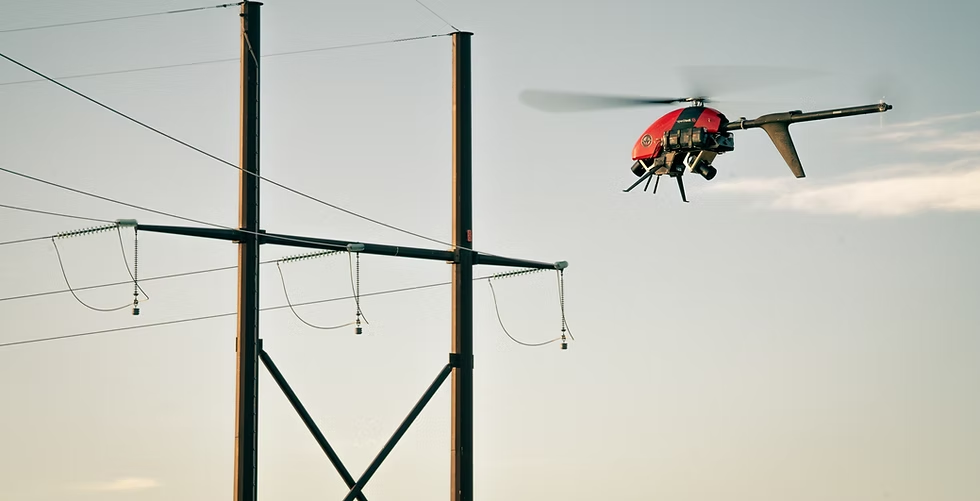
PAU operates a fleet of unmanned aircraft capable of meeting the need of the mission. From aerial drone LiDAR to long linear infrastructure aerial inspection, our proven platforms are selected for performance, reliability, and efficiency.
IS-BAO Registered
The International Standard for Business Aircraft Operations (IS-BAO), established by the International Business Aviation Counsel (IBAC), is based on the International Civil Aviation Organizations (ICAO) Standards and Recommended Practice (SARPS). These standards and recommended practices are recognized worldwide in the aviation industry as the code of best practices for a high level of safety and professionalism. The Federal Aviation Administration (FAA), Civil Aviation Authority (CAA), and European Committee for Standardization (CEN) recognize IS-BAO registered companies as having a positive safety culture and demonstrated operational excellence.
Phoenix Air Unmanned, LLC (PAU) is the first company worldwide to be registered under IS-BAO Remotely Piloted Aircraft System (RPAS) standards. As a leader in the Unmanned Aviation industry, PAU has successfully demonstrated operational efficiency, and a commitment to aviation safety, and has aided in the development of RPAS standards. PAU goes above and beyond the required regulations, and PAU’s commitment to excellence has granted them international recognition. PAU has led the efforts to operate under the same standards and recommended practices as manned aviation and to further shape and grow the Unmanned Aviation industry.
Customizable Payloads
Whether flying drones for LiDAR aerial survey, aerial inspections, or cinema, PAU uses custom payload integrations to meet mission needs. Our unmanned aircraft are purposefully selected to offer adaptability in payload mounting.
PAU staffs dedicated aerospace engineers to design custom payload solutions. We have access to the manned aviation resources of Phoenix Air Group, Inc., which provide parts manufacturing, CNC machining, and licensed A&P technicians to complete world-class payload integrations.
Mobile Versatility
Customized operations vehicles offer PAU flight crews mobile ground control stations, airspace awareness, and surveillance, data organization and post-processing stations, and dedicated maintenance centers for unmanned aircraft system (UAS) flight operations.
Systems are powered by onboard generators sufficient for battery charging, maintaining battery backups for light-critical components, and verification of high-quality drone data capture.